M MurmTools

four browser tools · three in the chrome web store · no servers

Every number says where it came from.

Four browser tools for competitor and privacy research — three of them in the Chrome Web Store today. Each one marks every figure it prints with how that figure was arrived at — counted, computed, or refused outright because no such number exists. Nothing is sent anywhere. There is no server to send it to.

Share of 5,294 sites that had contacted an outside company — by milliseconds since the page began loading

counted · consent-gap-2026.json · 2026-08-05
Counted, not modelled: one cold load per site, Tranco top-1M in rank order, measured 5 August 2026 from the Netherlands. Download the raw data (JSON, 5,294 sites) · CC BY 4.0
Counted. 1,247 Tests passing 570 in MurmSpy, 447 in MurmAds, 215 in MurmStack, 15 in MurmProof. Counted from the suites, today.
Counted. 0 Servers Not “we don’t log”. There is nowhere to log to. No account, no endpoint, no analytics.
Counted. 317 Domains mapped to companies 243 parent companies, 70 of them in the business of tracking people. A file in the package, not a lookup.
Refused. People using these Chrome reports installs late and rounded. Copying that here would be a stale copy of someone else’s rounding, dressed as our own figure.

four tools · one system

Each one answers a question you can check.

They share a design system, three typefaces and a rule about honesty. They share no data, because none of them collects any. Under each one: what it refuses to measure — engraved, because the refusal is a feature of the instrument.

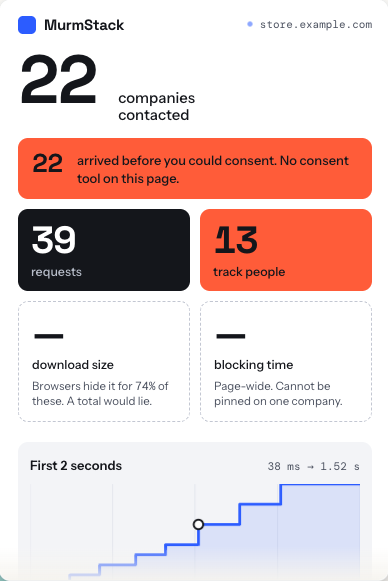
The MurmStack popup on store.example.com: 22 companies contacted, all 22 before you could consent, 39 requests, 13 that track people — and download size and blocking time drawn as dashed refusals at the same size.

MurmStack

privacy research · free

Click it on any page and it reports how many separate companies that page contacted, plotted at the millisecond each was first reached — and how many arrived before a cookie banner could realistically be answered.

  • Companies in the catalogue 243
  • Marked as tracking 70
  • Permissions 2
— download total · blocking time per company Browsers hide the transfer size of most cross-origin requests — a total built on that would understate reality while looking authoritative. The browser does not expose which script caused a long task, so blocking is reported page-wide and labelled as such.
Add to Chrome — free
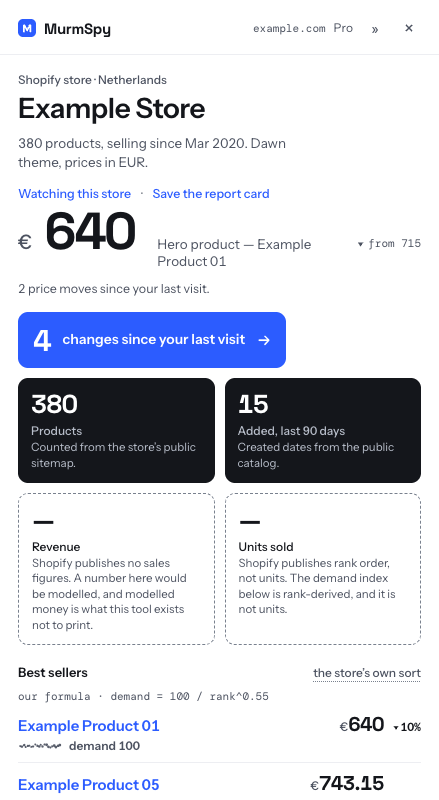
The MurmSpy popup on an example Shopify store: 380 products counted from the public sitemap, the hero product at €640, 4 changes since the last visit — and revenue and units sold drawn as dashed refusals at the same size.

MurmSpy

store research · free + pro

Store research on the storefront in front of you: best sellers in the merchant’s own order, pricing shape, app and theme detection with the evidence on the tile, and a watchlist that tells you what moved.

  • App fingerprints 137
  • Figures it refuses to model 2
  • Affiliate links, ever 0
— revenue · units sold Shopify publishes no sales figures — a number here would be modelled, and modelled money is what this tool exists not to print. Rank order is published, units are not.
Get it
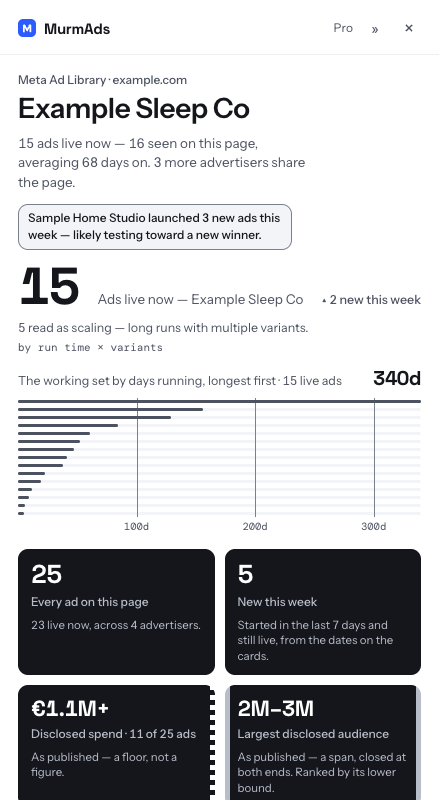
The MurmAds popup on the Meta Ad Library: 15 ads live now, 5 read as scaling by run time × variants, disclosed spend of €1.1M+ shown as a floor and the largest disclosed audience of 2M–3M kept as a span.

MurmAds

ad research · free + pro

Reads Meta’s own EU transparency disclosures on the Ad Library page. An interval stays an interval; a ceiling says only its upper end. Three of those four forms used to be printed as exact figures. They no longer are.

  • Bound forms kept distinct 4
  • Languages read 4
  • Invented figures 0
— exact spend · exact reach Meta does not publish exact spend for commercial ads. Under EU transparency rules it publishes spend and reach as ranges, and that range is the most precise figure that exists.
Add to Chrome
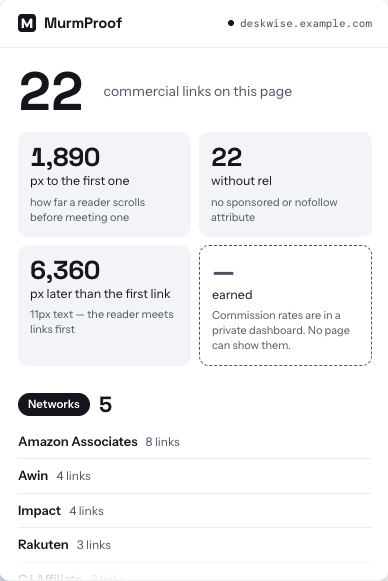
The MurmProof popup on an example page: 22 commercial links counted, 1,890 pixels of scrolling to the first one, 22 without a rel attribute — and earnings drawn as a dashed refusal at the same size.

MurmProof

disclosure research · free

Counts the commercial links on any page, reports how far a reader scrolls before meeting the first one, and measures in pixels where the affiliate disclosure sits relative to it. What a page claims, against what it discloses.

  • Affiliate networks it can name 11
  • Permissions 2
  • Earnings it estimates 0
— earnings Commission rates are agreed privately between publisher and network and appear nowhere in the page. Any per-click or per-page figure would be invented, so none is offered.
Add to Chrome — free

the rule

A figure looks different depending on how it was arrived at.

Four marks, and they separate from a metre away before a word is read. Two of them are already on this page: the tiles at the top are drawn in exactly the vocabulary the extensions use. The other two are missing on purpose — nothing here is modelled, and nothing here is behind a paywall, so printing them would be the fabrication this whole page argues against.

Counted We enumerated it, or did exact arithmetic on figures somebody published. Set in the display face.
Computed A formula with a chosen constant in it. Never the display face, and the rule is printed underneath.
Refused No such number exists and none can be had. Drawn at the size of a finding, because declining to guess is a result.
Withheld It exists and the paid tier holds it. A hatch, never a blur — a blur promises a value is under the glass.

No colour carries any of that. Fill, outline, dash and hatch are shapes, and the second channel is the typeface. Both survive a greyscale screenshot, every colour-vision deficiency and a black-and-white printout. An earlier version used a tint, and in dark greyscale that tint measured 1.68:1 against the thing it claimed to distinguish itself from. It was removed rather than adjusted.

questions

Questions people actually ask.

Are MurmTools extensions free?

MurmStack and MurmProof are free permanently with no paid tier. MurmSpy and MurmAds have permanent free tiers plus optional Pro at €8.99/month (€69/year) and €9.99/month (€79/year). No time-limited trials, no bundle, no account required for the free tiers.

Do MurmTools extensions send my browsing anywhere?

No. None of the four has a backend, so there is no server to send anything to. No account, no analytics, no telemetry. Watchlists and settings live in local browser storage, and even the typefaces are bundled rather than fetched from a font host.

Why does MurmSpy refuse to show Shopify revenue?

Shopify publishes no sales figures, so any revenue number would be modelled rather than measured. MurmSpy draws a refusal there — at the same size as a real finding — instead of printing a guess. Tools that show a revenue estimate are inferring it, usually from product count and price.

How is MurmStack different from Wappalyzer or BuiltWith?

Those report what a site is built with. MurmStack reports that plus who the page contacted and when — each company plotted at the millisecond it was first reached, and how many arrived before a consent banner could realistically be answered. It uses two permissions and no host access.

What does MurmAds do that the Meta Ad Library does not?

It reads Meta's own EU transparency disclosures and keeps their shape: an interval stays an interval, a ceiling states only its upper end, a floor only its lower. It adds a per-ad scaling signal derived from run time × variants, with that method printed beside it.

Which browsers do these work in?

Any Chromium browser — Google Chrome, Microsoft Edge, Brave, Arc and Opera. All four are Manifest V3 extensions; all four install from the Chrome Web Store.

Last updated .